
Interconnects Matter: Why Network Fabric Defines Supercomputer Performance
When people discuss supercomputers, they usually focus on processors and accelerators. These components perform the calculations, so the emphasis is understandable. Yet experienced practitioners know that the network connecting those components, often called the interconnect or fabric, is frequently what separates a high-performing system from a disappointing one. A supercomputer is not simply a large collection of fast computers. It is a single system whose components must cooperate continuously. That cooperation depends on the interconnect.
Why Communication Dominates
Most large-scale scientific and AI workloads divide a problem among many nodes. Each node works on its portion, but nodes must regularly exchange results with their neighbors or with the entire system. If this exchange is slow, nodes wait idle, and adding more processors yields diminishing returns. Interconnect performance therefore determines how well a system scales. A fast fabric allows thousands of nodes to work efficiently together; a slow one limits the useful size of the system.
Bandwidth and Latency
Two properties define interconnect performance. Bandwidth measures how much data can be transferred per second. Latency measures how long it takes for a message to travel from one node to another. Different workloads stress these properties differently. AI training, for instance, moves large volumes of data and is sensitive to bandwidth, while some simulations exchange many small messages and are sensitive to latency.
Topology Matters
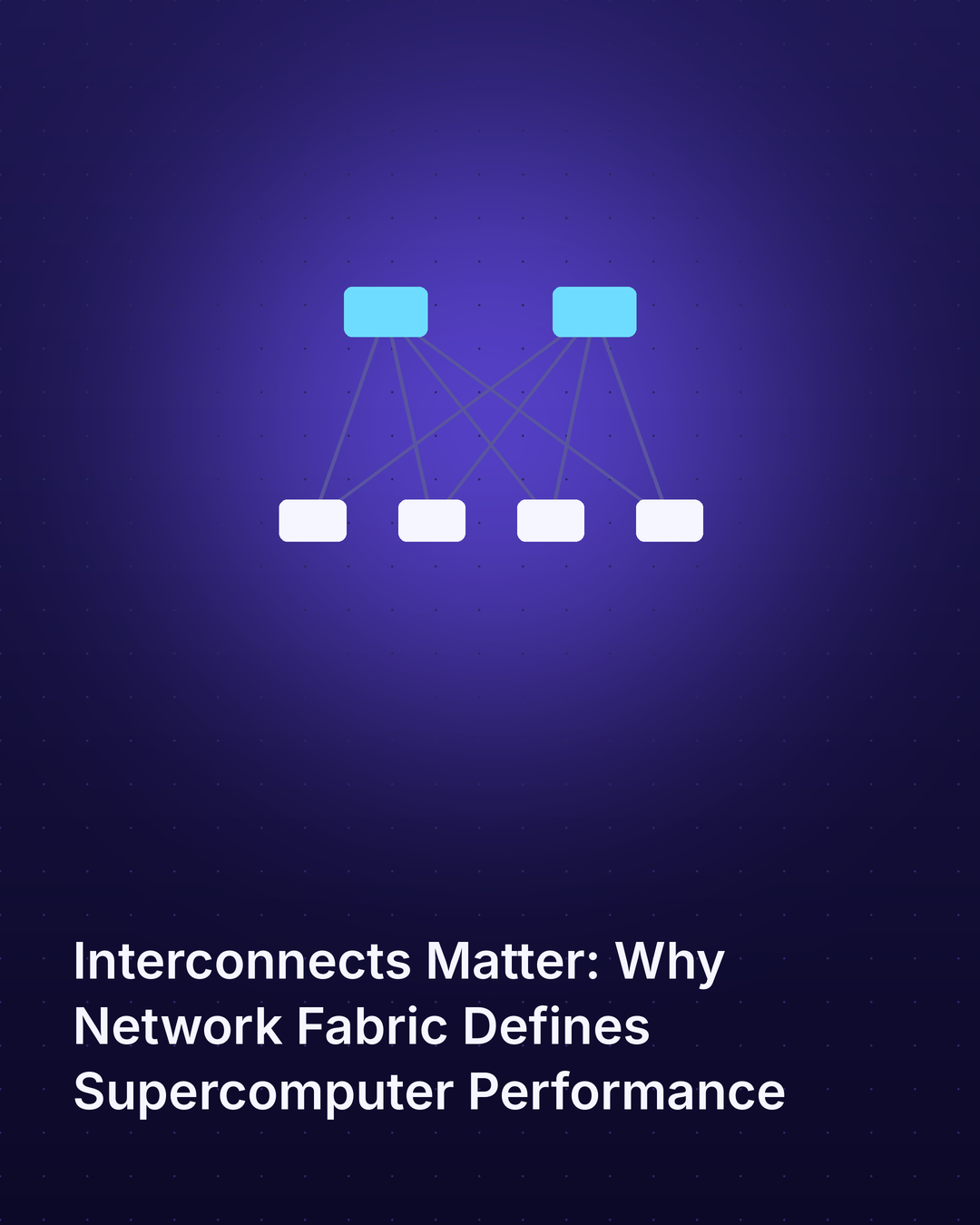
How nodes are connected, known as topology, affects both performance and cost. Some designs minimize the number of hops between any two nodes, reducing latency. Others prioritize cost efficiency or resilience. The right topology depends on the workloads and the scale of the system.
Congestion and Adaptive Routing
In large systems, many communications occur simultaneously, and traffic can become congested at certain points. Advanced interconnects use adaptive routing, sending traffic along less busy paths, and congestion control mechanisms that prevent any one job from degrading others.
The Rise of Advanced Ethernet
Specialized interconnect technologies have long dominated supercomputing. Increasingly, however, enhanced forms of Ethernet are being adopted, offering high performance with the familiarity and ecosystem of a widely used standard.
Evaluating an Interconnect
Organizations should test interconnects with their actual workloads rather than relying on peak specifications. Scaling tests, measuring how performance changes as more nodes are added, are particularly revealing.
Software also plays a role. Communication libraries tuned for a particular fabric can extract considerably more performance than generic implementations, and job schedulers that place related tasks close together on the network reduce traffic across the system. Organizations should confirm that their preferred applications and libraries are well optimized for the interconnect under consideration.
The Bottom Line
The interconnect is often the defining component of a supercomputer’s performance. Bandwidth, latency, topology and congestion management determine how well a system scales. Organizations investing in high-performance or AI infrastructure should give the fabric the same scrutiny they give processors. Testing with real workloads reveals what specifications cannot. A well-designed interconnect turns a collection of powerful nodes into a genuinely powerful system.